
The art of Negotiation is one of the most important skills in business. Whether you are discussing a price with a client, signing a partnership agreement, negotiating a salary, or closing a major business deal, your ability to negotiate can directly affect your results.
Successful negotiation is not about forcing the other person to accept your terms. It is about finding a solution that creates value for both sides while protecting your interests.
In this guide, we will explore the art of negotiation, effective business negotiation strategies, common mistakes to avoid, and practical tips for closing successful business deals.
What Is Business Negotiation?
Business negotiation is a discussion between two or more parties to reach an agreement that satisfies their respective interests.
Negotiations can involve:
- Price and payment terms
- Contracts and agreements
- Business partnerships
- Sales and purchases
- Salaries and compensation
- Delivery timelines
- Services and project requirements
- Investments
- Vendor agreements
- Long-term business relationships
A successful negotiation should ideally result in an agreement where both parties understand the value they are receiving.
Why Is Negotiation Important in Business?
Negotiation plays a major role in business because almost every business relationship involves some form of agreement.
Strong negotiation skills can help you:
- Get better prices and payment terms
- Increase business profits
- Build stronger partnerships
- Resolve conflicts
- Close more sales
- Reduce unnecessary costs
- Protect your business interests
- Create long-term relationships
- Make better business decisions
For entrepreneurs and business professionals, negotiation is not just a communication skill—it is an important business growth skill.
10 Effective Negotiation Tips for Successful Business Deals
1. Prepare Before the Negotiation
Preparation is one of the most important parts of successful negotiation.
Before entering a business negotiation, understand:
- What you want
- What the other party wants
- Your minimum acceptable outcome
- Your ideal outcome
- Your alternatives
- The market price
- The other party’s possible alternatives
The more information you have, the more confidently you can negotiate.
Tip: Never enter an important negotiation without knowing your numbers and priorities.
2. Know Your BATNA
BATNA stands for Best Alternative to a Negotiated Agreement.
In simple words, your BATNA is what you will do if the current negotiation does not result in a deal.
For example, if you are negotiating with a supplier and they refuse your required price, your BATNA could be another supplier offering similar products.
Knowing your BATNA gives you confidence because you are not dependent on one deal.
3. Understand the Other Party’s Needs
Great negotiators do not focus only on what they want.
They also ask:
“What does the other person actually need?”
For example, a client may not simply want a lower price. They may care more about:
- Faster delivery
- Better support
- Quality
- Flexible payment
- Reliability
- Long-term service
Understanding these priorities can help you create an offer that works for both sides.
4. Listen More Than You Speak
Listening is one of the most underrated negotiation skills.
Instead of immediately responding to an offer, listen carefully and ask questions.
Useful questions include:
- “What is most important to you in this agreement?”
- “What concerns do you have about the proposal?”
- “What would make this deal more valuable for you?”
- “What timeline are you working with?”
The answers can reveal opportunities that you might otherwise miss.
5. Don’t Make Price the Only Discussion
Many people believe negotiation is simply about getting the lowest price.
That is not always true.
A business deal can include several negotiable factors:
Price + Quality + Timeline + Payment Terms + Support + Quantity + Contract Length
For example, instead of reducing your price, you might offer faster delivery or additional support.
This creates more flexibility without unnecessarily reducing your profit.
6. Make the First Offer Strategically
The first offer can influence the direction of a negotiation.
If you have strong market knowledge and understand the value of your product or service, making a reasonable first offer can help establish a useful starting point.
However, avoid making unrealistic demands.
Your first offer should be:
- Reasonable
- Defensible
- Based on market information
- Connected to the value you provide
7. Focus on Value, Not Just Cost
A powerful negotiation strategy is to explain the value behind your offer.
Instead of saying:
“Our service costs ₹50,000.”
Explain what the client receives for that investment.
For example:
“The ₹50,000 package includes strategy, implementation, reporting and ongoing support.”
When people understand the value, price becomes only one part of the conversation.
8. Use Silence Effectively
Silence can be surprisingly powerful during negotiations.
After making an offer, do not immediately fill every pause with additional explanations or discounts.
Give the other person time to think.
Sometimes the person will respond with useful information that can help you understand their actual position.
9. Stay Calm and Professional
Negotiations can become emotional, especially when money or important business decisions are involved.
Avoid:
- Anger
- Personal attacks
- Aggressive language
- Emotional decisions
- Unnecessary pressure
Stay calm and focus on the problem rather than the person.
A professional negotiation protects not only the current deal but also the future business relationship.
10. Know When to Walk Away
Not every deal is a good deal.
One of the most important negotiation skills is knowing when to say no.
You should consider walking away when:
- The deal creates unacceptable risk
- The expected profit is too low
- The terms are unfair
- The other party is unwilling to compromise
- The agreement conflicts with your business goals
A strong alternative can give you the confidence to reject a bad deal.
Win-Win Negotiation: What Does It Mean?
A win-win negotiation is an approach where both parties receive meaningful value from the agreement.
It does not necessarily mean that both parties get everything they want.
Instead, the goal is to identify shared interests and create a solution that benefits both sides.
For example:
A supplier wants a larger order.
A buyer wants a lower price.
The two parties might agree to a larger quantity at a reduced per-unit price.
The supplier gets more business, while the buyer gets better pricing.
This is an example of creating value instead of simply dividing value.
Common Business Negotiation Mistakes
Even experienced professionals can make negotiation mistakes.
Negotiating Without Preparation
Entering a negotiation without knowing your objectives can result in poor decisions.
Accepting the First Offer Too Quickly
The first offer may not represent the other party’s best possible offer.
Focusing Only on Price
Price is important, but other terms can be equally valuable.
Talking Too Much
Over-explaining your position can reveal information that weakens your negotiating position.
Making Emotional Decisions
Business decisions should be based on facts, value and long-term objectives.
Failing to Confirm the Agreement
A verbal agreement can lead to misunderstandings. Important terms should be documented clearly.
How to Negotiate a Business Deal Step by Step
Here is a simple business negotiation process:
Step 1: Define your objectives
Know exactly what you want from the deal.
Step 2: Research the market
Understand competitors, pricing, industry standards and alternatives.
Step 3: Identify the other party’s interests
Find out what matters most to them.
Step 4: Establish your BATNA
Know your best alternative if the negotiation fails.
Step 5: Start the discussion
Build rapport and establish the key issues.
Step 6: Exchange proposals
Discuss price, terms, timelines and responsibilities.
Step 7: Look for trade-offs
Exchange lower-priority concessions for things that matter more to you.
Step 8: Reach an agreement
Make sure both parties understand the final terms.
Step 9: Put everything in writing
Document the agreement, responsibilities, payment terms and deadlines.
Negotiation Example for a Small Business
Imagine a digital marketing agency quotes ₹80,000 for a three-month project.
The client says:
“₹80,000 is too expensive. Can you do it for ₹60,000?”
Instead of immediately reducing the price to ₹60,000, the agency could explore the client’s priorities.
For example:
“We can look at adjusting the scope. If you want to stay close to ₹60,000, we could reduce the number of deliverables while keeping the core strategy and reporting.”
This approach protects the agency’s value while giving the client flexibility.
Best Negotiation Skills to Develop
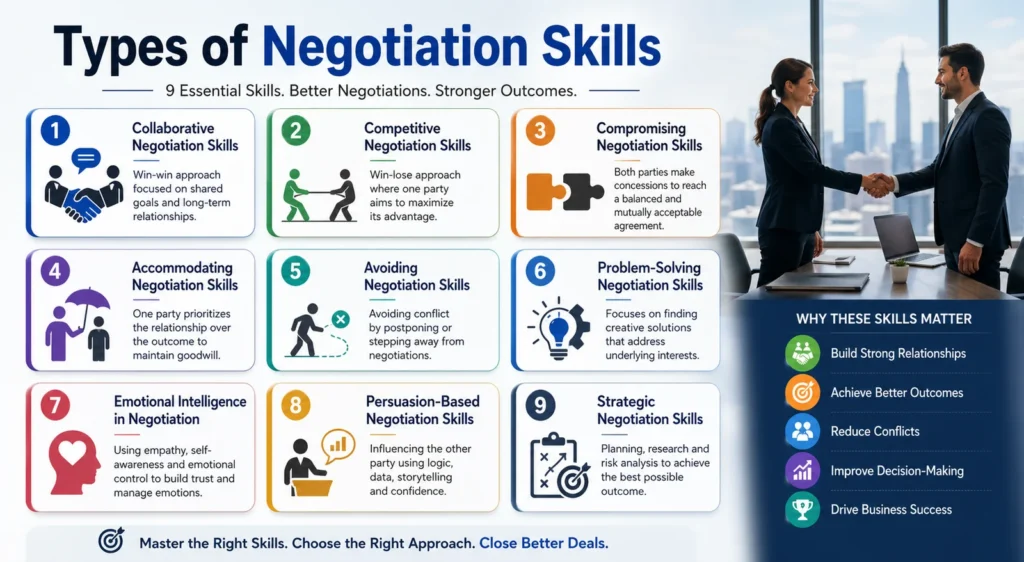
If you want to become a better negotiator, focus on developing these skills:
- Active listening
- Clear communication
- Market research
- Emotional control
- Problem-solving
- Strategic thinking
- Questioning
- Patience
- Persuasion
- Decision-making
The best negotiators are not necessarily the loudest people in the room. They are often the people who understand the situation most clearly.
How to Improve Your Negotiation Skills
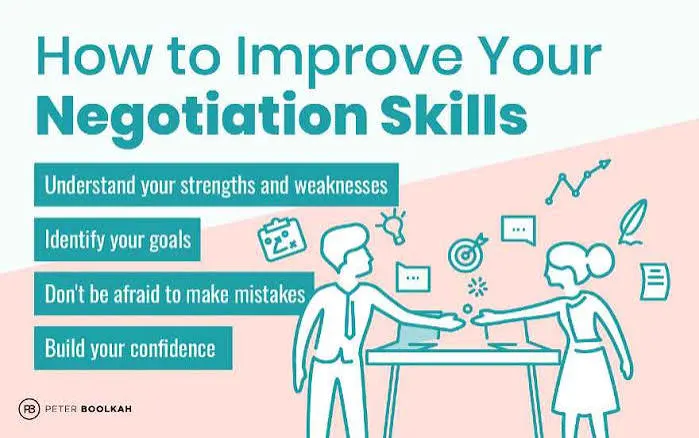
The art of Negotiation improves through practice.
You can start by:
- Practicing negotiation with friends or colleagues
- Studying successful business deals
- Learning to ask better questions
- Researching market prices
- Reviewing your previous negotiations
- Practicing different negotiation scenarios
- Learning to identify your BATNA
- Recording your goals before important meetings
After every negotiation, ask yourself:
What worked? What did not work? What could I have done differently?
This simple review process can significantly improve your negotiation ability over time.
Frequently Asked Questions About The art of negotiation
What is the most important rule of negotiation?
The most important rule is to understand both your own interests and the other party’s interests. Good preparation and clear communication create stronger negotiating positions.
What are the 5 key principles of negotiation?
Five important principles are preparation, understanding interests, creating value, communicating clearly, and knowing when to walk away.
How do you negotiate a better business deal?
Research the market, define your objectives, understand the other party’s priorities, establish your alternatives, negotiate multiple terms instead of only price, and document the final agreement.
What is a win-win negotiation?
A win-win negotiation aims to create an agreement where both parties receive meaningful value rather than one party simply winning at the expense of the other.
How do you negotiate price professionally?
Explain the value of your product or service, understand the buyer’s priorities, research market rates and consider negotiating other terms such as quantity, payment schedule, delivery or scope.
What should you never do during a negotiation?
Avoid lying, making emotional decisions, insulting the other party, revealing unnecessary information, accepting unfair terms under pressure, and negotiating without preparation.
Final Thoughts
The art of negotiation is not about winning every argument. It is about creating agreements that make business sense while maintaining strong professional relationships.
Successful negotiators prepare carefully, listen actively, understand the other party’s needs, communicate value and remain willing to walk away from deals that do not make sense.
Whether you are an entrepreneur, salesperson, freelancer, manager or business professional, improving your negotiation skills can help you make better deals and create long-term business opportunities.
Remember: The strongest negotiation is not necessarily the one where you get everything you want. It is the one where you create enough value for both sides to confidently say yes.
Quick Takeaways
- Prepare before every important negotiation.
- Know your BATNA and alternatives.
- Understand the other party’s needs.
- Focus on value instead of price alone.
- Listen carefully and ask strategic questions.
- Stay calm and professional.
- Look for win-win solutions.
- Negotiate multiple terms, not just price.
- Document important agreements.
- Know when to walk away.
Thanku for reading The Art of Negotiation: Tips for Successful Business Deals